
Ramadan brings a significant surge in parcel and hampers shipments. However, while many brands are prepared in terms of products and packaging design, they may not have considered standardizing their shipping box sizes. This is one of the factors that most directly impacts operations.
Boxes that are too large allow items to shift during transit and increase logistics costs due to volumetric weight calculations. Boxes that are too small compress the products and increase the risk of damage.
Research from the Packaging Association shows that 23% of packaging waste comes from using boxes that are larger than necessary. During peak season distribution, the impact is even greater.
This article discusses the most effective parcel box sizes for intercity shipping during Ramadan and how to determine them according to operational needs.
Operational Factors That Determine Parcel Box Size
Identify several variables that need to be mapped first, as the optimal box size cannot be determined without understanding the product characteristics and distribution routes.
- Product dimensions and shape. Irregularly shaped or tall products require separate calculations, unlike flat or box-shaped products.
- Total parcel weight. The heavier the contents, the stronger the box construction required, and the size should be adjusted to prevent excessive pressure on any single point.
- Product type. Fragile items, such as glass jars, liquids, or sensitive food products, require more space for padding compared to non-fragile items.
- Stacking system during transport. Boxes will be stacked in vehicles and warehouse facilities. Disproportionate sizes make stacking difficult and increase the risk of collapse.
- Shipping duration and route. Intercity shipments that pass through multiple transit points require boxes with stronger structures compared to local deliveries.
Common Standard Parcel Box Sizes for Intercity Shipping
Based on common e-commerce and hampers distribution practices in Indonesia, there are three size categories most frequently used.
1. Small Parcel
Suitable for hampers containing 3–5 small items, such as cookies, sachet drinks, or small skincare products. Common dimensions are approximately 25 x 20 x 15 cm.
Leave 2–3 cm of space on each side for padding and inserts, and 5–8 cm at the top for the lid and cushioning. The total weight of the contents should ideally not exceed 2 kg to ensure the box construction can support it without deforming during intercity transit.
2. Medium Parcel
This category is most commonly used for standard Ramadan hampers containing 6–8 mixed items, including food, drinks, or personal care products. Common dimensions are approximately 35 x 28 x 18 cm.
For this category, the contents typically weigh between 2–4 kg. Ensure that the weight is evenly distributed inside the box rather than stacked on one side, as the box may shift multiple times at transit points during intercity shipping.
For further reference on hamper box construction in this category, you can consult the complete guide on premium hampers boxes.
3. Large Parcel
Next, for corporate hampers or premium packages containing 8–12 items or more, common dimensions range from 40 x 32 x 20 cm to 45 x 35 x 22 cm. VIP hampers with 10–15 items typically use dimensions around 45 x 35 x 22 cm.
In this category, the contents can weigh between 4–7 kg. The box construction should be reinforced at the base and corners because the stacking pressure during intercity distribution is much higher.
For large-volume corporate hampers, the corporate hampers guide can serve as a relevant reference.
Strategies for Determining the Optimal Box Size for Ramadan Peak Season
1. Standardizing the Number of Size Variations
One decision that impacts operational efficiency is limiting the number of box size variations. Ideally, a brand should prepare 2–3 standard sizes that cover all of its product variants.
This allows the packing process to be faster, as the team does not need to reconsider which box to use for each order. Packaging inventory is also easier to manage, and there is no excess stock of sizes that go unused after the peak season.
2. Optimizing the Ratio of Contents Volume to Box Volume
Empty space inside the box is a common issue during shipping. Products that move freely within the box are more prone to collisions and can be easily damaged when the box is jostled during transit.
PRO TIP! Empty space should not exceed 15–20% of the total box volume. The remaining space should be filled with products or padding. If, after calculation, the empty space is still too large, consider using a smaller box with thicker padding.
3. Intercity Shipping Simulation Test
Before Ramadan, conduct a test shipment using the final box to the largest distribution cities. Send samples via the same courier routes that will be used during the peak season.
Check the condition of the box and its contents upon arrival. If there are signs of deformation, shifting of contents, or any product damage, revise the box size or construction before handling large volumes.
Business Insight: Standardizing Box Sizes Reduces Operational Risks
For example, an F&B brand that regularly ships Ramadan hampers to 10 cities with a volume of 2,000 orders per month previously used six different box sizes to accommodate each product variant.
The issues that arose included slower packing processes because the team had to select the correct box size for each order. Box inventory became unbalanced due to inaccurate size projections. Most costly of all, some boxes were larger than necessary for the actual products, resulting in higher volumetric shipping charges.
After they standardized to just three sizes (small, medium, and large) that covered all product variants, several improvements occurred. Packing time per unit decreased because the team no longer had to rethink box selection for each order.
Repacking errors decreased because the options were more limited and clearer. Packaging inventory became easier to manage since forecasting was needed for only 3 box SKUs instead of 6.
Data from the Packaging Association shows that 23% of packaging waste comes from using boxes that are larger than the actual product requirements.
For example, at a scale of 2,000 orders per month, even small per-unit savings from volumetric efficiency and reduced repacking can have a significant impact by the end of the month.
For custom eid hampers boxes with sizes tailored to the distribution scale, early planning is very helpful to avoid last-minute revisions once the peak season is underway.
Conclusion
Standardizing box sizes can protect products during intercity transit while also reducing unnecessary distribution costs.
Planning box sizes before Ramadan allows time for testing, revisions, and production without time pressure. As a result, shipments run smoothly, and damage-related complaints are reduced.
If you are currently in the packaging planning stage for this year’s Ramadan, ALVAboard offer two size options from the AB Ramadan line, specifically for parcels and Eid hampers.
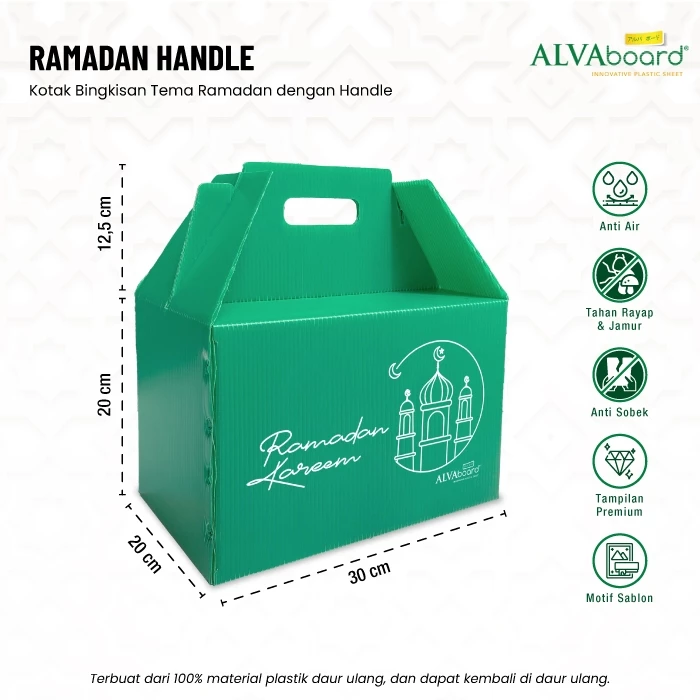
The AB Ramadan Handle measures 30 x 20 x 32.5 cm with a top handle, making it suitable for hampers that are delivered directly to recipients.
The AB Ramadan Gift Box measures 35 x 25 x 15 cm with a lid, making it more suitable for intercity shipping due to its compact size and stacking stability.
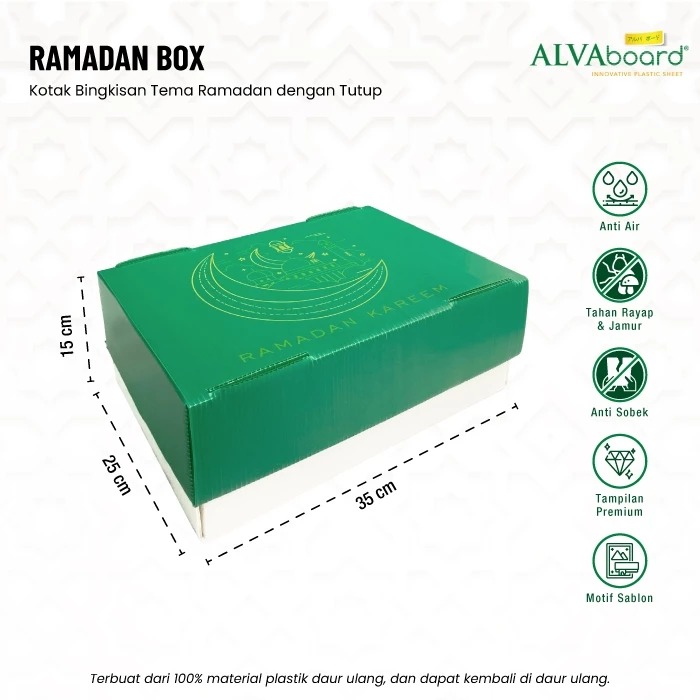
Both are made from 3 mm polypropylene, which is water-resistant, termite-proof, and safe for direct contact with food, so no additional lining is needed for F&B products.
Alternatively, if you need custom options tailored to your brand, you can also consult and contact the ALVAboard team directly via WhatsApp!
We hope you find this helpful!