In bottled beverage factories with high production volumes, WIP boxes function to support the load of semi-finished products, ranging from preforms to empty bottles, in vertical stacks that can reach several layers at once. The load borne by the container at the bottom position increases as the number of stacks above it grows.
Problems arise when the boxes used are not designed for such loads. Deformation in the bottom box can damage the products inside, disrupt stack stability, and trigger downtime.
Mistakes in determining the specifications early on can lead to multiple layers of losses, ranging from product and box replacement costs to disruptions in the production line workflow.
Technical Specifications of Stack-Resistant PP WIP Boxes
Load Capacity
Load capacity refers to the maximum load a box can bear without experiencing permanent deformation. For stacking needs in beverage factories, load capacity must be calculated based on the total load from all layers stacked above a single box unit.
Thanks to the high density of polypropylene material, PP WIP boxes excel at supporting heavy stacking loads. Unlike cardboard or thin plastic, the PP structure does not absorb moisture, allowing its strength to remain stable and preventing it from weakening during factory operations.
2. Reinforcement Structure Design
The structural design of the box, including the placement of reinforcing ribs on the walls and base of the box, the distribution of support points, and the rigidity of the corners, determines how the load is distributed throughout the entire structure.
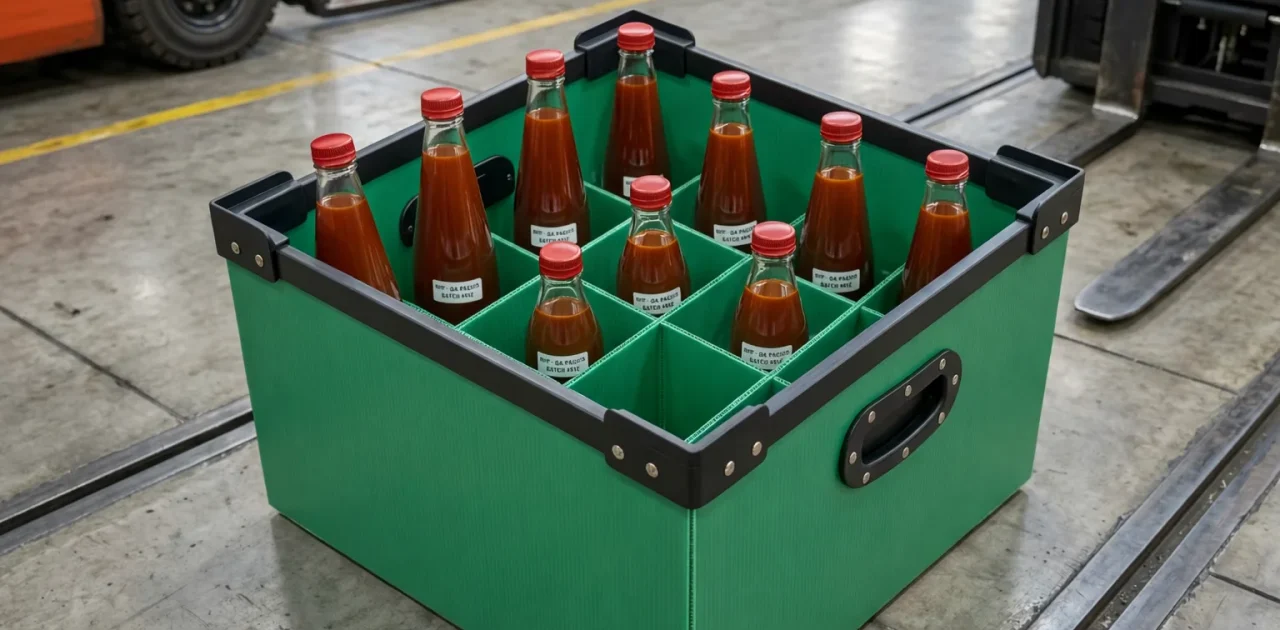
Boxes with reinforcing ribs distribute the load evenly, preventing any single point from bearing excessive pressure. Additional corner accessories also help maintain the stability of the box corners when stacked under full load.
3. Stacking Stability
A strong box is not necessarily stable when stacked. Stacking stability is determined by the dimensional precision between units, the interlocking design of the box’s top and bottom surfaces, and the flatness of the base after bearing repeated loads.
4. Dimensions and Production Line Compatibility
The box size must be compatible with the conveyor system, storage racks, and the dimensions of the existing production line. Boxes that are too large or too small compared to the system standards can create inefficiencies at every transfer point, from the production line to buffer storage, and from buffer storage to the warehouse.
In bottled beverage factories, the box dimensions must also consider capacity per layer to avoid excessive empty space that could cause products to move and collide during handling.
5. Hygienic Design
Beverage production environments require strict hygiene standards. The WIP boxes used must be easy to clean, have no gaps or porous surfaces that could allow dirt or bacteria to accumulate, and be resistant to the cleaning agents used in routine sanitation processes.
Smooth surfaces and a design without dead corners are two characteristics that most determine the ease and effectiveness of the cleaning process in F&B production environments.
6. Production Environment Resistance
Bottled beverage factories operate in environments with high humidity from the filling process, temperature variations between production areas and cold storage, and exposure to cleaning liquids. WIP boxes must be able to maintain their structural performance under all these conditions without material degradation.
Heat resistance is also relevant for certain production areas, particularly those located near sterilization machines or hot-fill processes.
Parameters to Check Before Choosing a PP WIP Box
Before deciding on the specifications, there are six operational parameters that need to be verified within the facility:
- Maximum load per stacking layer, calculated from the product weight multiplied by the number of units per box.
- Actual stacking height in the production area and warehouse, to determine the total load borne by the bottom box.
- Average weight of the semi-finished products per batch to be stored.
- Daily handling frequency, as boxes that are moved frequently require higher impact resistance.
- The cleaning system used, to ensure the box material is compatible with the type and concentration of cleaning agents applied.
- Compatibility with the internal logistics system, including rack dimensions, conveyors, and existing handling equipment.
Ideal Applications of Stack-Resistant PP WIP Boxes in the Beverage Industry
PP WIP boxes with appropriate stacking specifications are most relevant for use at the following production points:
- Preform storage before the blowing machine.
- Handling of empty bottles before the filling process.
- Transfer of semi-finished products between production lines.
- Buffer storage in high-speed production areas where product flow needs to be maintained.
- Staging areas in the warehouse before products enter the final packaging stage.
Conclusion
Not all PP boxes are designed to withstand heavy stacking loads in industrial production environments. Load capacity, reinforcement structure design, dimensional stability, and environmental resistance are the four key factors that determine whether a box is truly suitable for the needs of bottled beverage factories.
Selecting the right specifications from the beginning helps protect semi-finished products from damage, maintain smooth production line operations, and reduce the cost of frequent box replacements.
ALVAboard provides WIP boxes made from premium polypropylene (PP) that are impact-resistant, pressure-resistant, water-resistant, mold-resistant, and capable of withstanding temperatures up to 130°C.
Equipped with corner accessories for stacking stability and handles for easier handling, these boxes can be used hundreds of times without losing their structural strength. They are available in five color variants to facilitate identification across production lines.
For consultation on specifications that match your production facility needs, you can refer to the WIP Box manufacturer page and the WIP Box specification guide based on production flow, or contact ALVAboard directly for further discussion.