As Ramadan approaches, the volume of production and distribution for consumer goods surges significantly in a short period of time. Warehouses that normally operate at standard capacity suddenly need to accommodate large stocks, while delivery fleets run on tighter schedules and longer routes than usual.
One of the consequences of this surge is pallet stacking that goes higher than normal standards. With limited warehouse space, operators are forced to stack products higher to maximize storage capacity.
This is where invisible damage risks begin to develop.
Many product damages during the Ramadan peak season actually do not occur on the road — they happen in warehouses and during the loading process. The causes include unevenly distributed stacking pressure, minor shifts during forklift handling, and load imbalances between layers.
The good news is that PP layer pads are designed to address exactly these problems. Read on for a full explanation.
Why Does High Stacking Become a Major Risk During Peak Season?
Limited warehouse space during peak season pushes operators to maximize stacking height as their first solution.
As a result, vertical pressure on the bottom layer increases with every additional tier added to the stack. Products on the lower layers bear the cumulative weight of everything stacked above them. If the product packaging cannot withstand that load, the consequence is packaging deformation.
Transportation movement further amplifies the existing risks. Vehicle vibrations, sudden braking, and road maneuvers cause unevenly distributed loads on the pallet to shift and slide. Without a stabilization mechanism between layers, these small movements accumulate and can cause the entire stack structure to become unstable.
How Do PP Layer Pads Reduce the Risk of Damage?
1. More Even Load Distribution
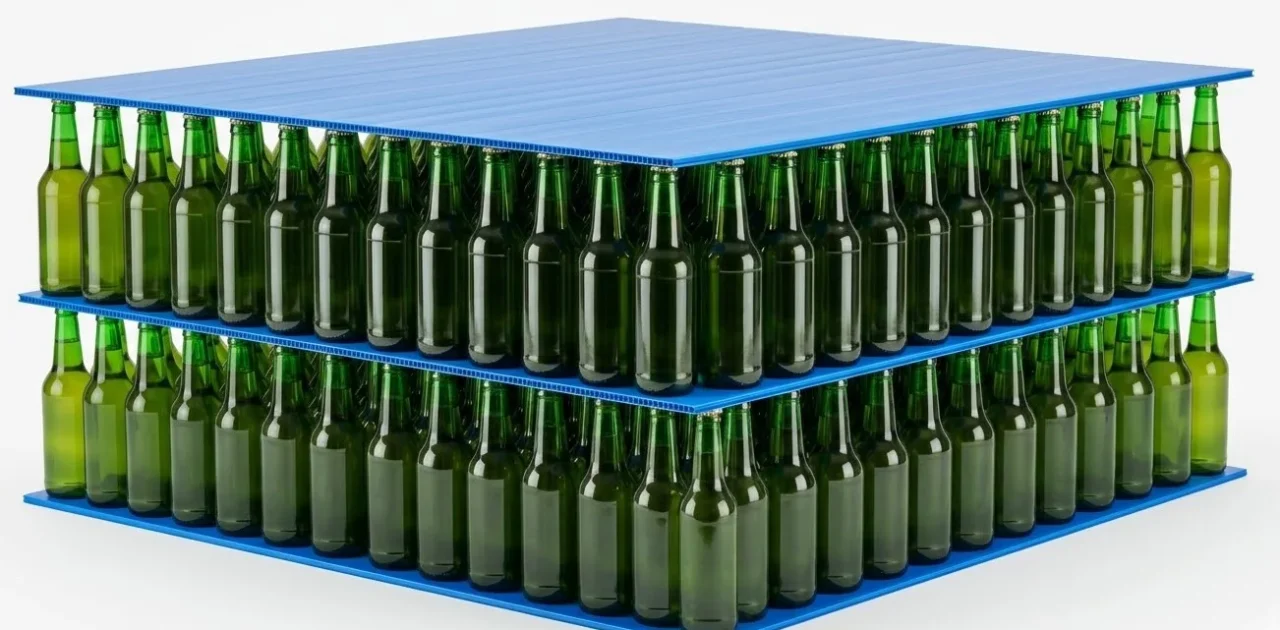
PP layer pads function as an intermediate platform between layers, spreading the load evenly across the entire surface of the layer beneath. The corrugated structure within the PP material produces a far more uniform pressure distribution compared to direct contact between product packaging.
This even load distribution means no single point bears excessive pressure — reducing the risk of packaging deformation on lower layers that are vulnerable to cumulative pressure from the layers above.
2. Inter-Layer Stability
PP layer pads provide a consistent, stable surface for each product layer placed on top. When products are placed on a layer pad, they have a flat and solid platform that prevents lateral shifting during handling and transportation.
This stability is especially important during forklift movement and loading onto delivery fleets, where sudden acceleration and deceleration can cause product layers to shift if no adequate stabilization mechanism is in place.
3. Packaging Structure Protection
Direct contact between product packaging in a stack — without an intermediate layer — creates pressure and friction that can damage the outer packaging. The corners and edges of upper-layer packaging can press against the surfaces of lower-layer packaging, causing damage that compromises packaging integrity.
PP material is also moisture-resistant, protecting packaging from humid warehouse conditions that are common during peak season.
4. Overall Pallet Structure Reinforcement
PP layer pads transform a product stack from a loose arrangement of packaging resting on each other into an integrated structure, with each layer pad acting as a binding element between tiers. The result is a pallet that is more stable during handling, more resistant to external disturbances, and safe for high stacking.
Impact of Layer Pads on Warehouse Operational Efficiency
There are several operational impacts that can be felt directly at the warehouse management level.
- Higher stacking without increased risk. Storage capacity can be increased without physical space expansion — highly useful during peak season when additional capacity is difficult to obtain on short notice.
- More optimal use of warehouse space. Safer and higher stacking capability makes it easier for operators to maximize available cubic space.
- Improved stability during forklift handling. A stable pallet reduces safety risks for forklift operators while minimizing product damage during handling.
- Faster loading process. Operators no longer need to make repeated adjustments to stabilize shifting stacks.
- Consistent pallet structure across shipments. The use of layer pads simplifies load planning and ensures fleet capacity is utilized optimally on every delivery trip.
Impact of Layer Pads on Distribution Costs
The cumulative savings generated by using PP layer pads across multiple points in the distribution chain far outweigh the cost of procurement.
- Reduction in damaged products. During peak season with high distribution volumes, even a small decrease in the damage rate can produce significant savings.
- Fewer distribution claims. Claims submitted by distributors or retailers consume administrative operational time and risk damaging business relationships.
- More efficient pallet utilization. Every pallet that can be stacked higher safely reduces delivery trips and lowers logistics costs per unit distributed.
- Reduced need for re-packing. Products arriving in unstable or damaged stacks often require re-packing before they can be distributed further. Layer pads minimize this need.
- High ROI from damage prevention. Layer pads that can be reused across multiple distribution cycles generate a progressively lower cost per use over time.
Conclusion
Damage from high stacking is often overlooked in Ramadan peak season distribution planning, yet its financial impact accumulates significantly throughout the intensive distribution period.
PP layer pads offer a practical solution by distributing loads more evenly, stabilizing stack structures, and protecting packaging integrity at every layer.
Their implementation reduces losses from damaged products, lowers distribution claims, and improves the efficiency of warehouse capacity and fleet utilization.
For more information, you can read our articles on the benefits of using layer pads and available reusable layer pad options.
If you are looking for a reliable PP layer pad manufacturer for your Ramadan distribution needs or long-term logistics operations, ALVAboard is a local procurement partner worth considering.
Consult your layer pad needs with ALVAboard today!