When procurement teams ask about the price of PP WIP boxes, the answer they most often receive is: “It depends on the specifications.” This response reflects the reality that custom boxes have no standard price that applies universally.
Differences in size, load capacity, design complexity, and order volume can result in per-unit prices that vary by several multiples. By understanding these factors, procurement teams can prepare more accurate briefs, receive more relevant quotations, and avoid design revisions that waste both time and money.
This article covers the price range of custom PP WIP boxes and the technical factors that most significantly determine the final figure in a supplier quotation.
General Overview of Custom PP WIP Box Pricing in the Industry
PP WIP boxes are available in two categories:
- Standard boxes with dimensions and specifications predetermined by the manufacturer
- Custom boxes designed to meet the specific operational requirements of the client
Standard boxes cost less per unit because there are no tooling costs and the production process is already optimized.
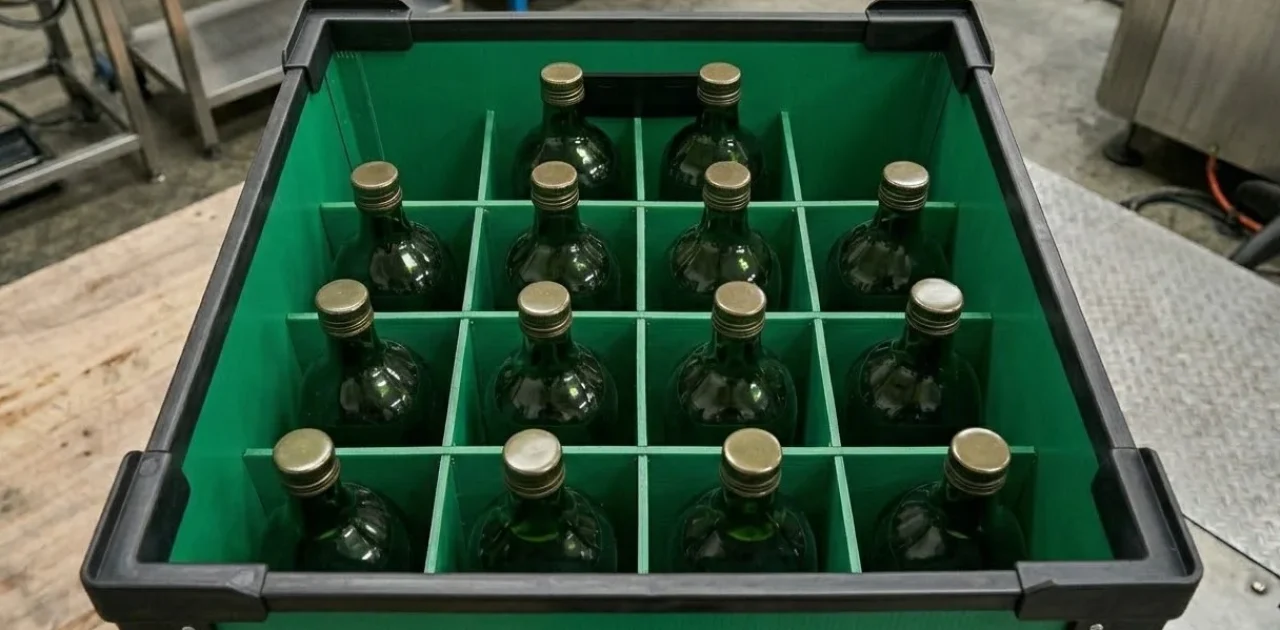
However, for bottled beverage factories with specific bottle dimensions, product weights, and stacking requirements, standard boxes often fail to deliver an optimal operational fit. A box that is too large increases the need for additional packaging materials and reduces stacking efficiency. A box that is too small risks product stability during transportation.
A custom box precision-engineered for specific product dimensions and weights is actually more economical in the long run, despite a higher initial per-unit price. This is because a precise fit reduces the need for supplementary protective materials, improves stacking efficiency, and minimizes product damage during distribution.
In general, the price range for custom PP WIP boxes in the Indonesian market falls between Rp35,000 and Rp250,000 per unit, depending on design complexity and order volume — with considerable variation between those two figures.
Key Factors That Determine the Price of a Custom PP WIP Box
1. Box Dimensions and Volume
The larger the box volume, the more PP material is required per unit. For bottled beverage factories, box dimensions are determined by bottle size, the number of bottles per layer, and the number of layers planned.
2. Load Capacity Specifications
WIP boxes for bottled beverage factories must be able to withstand the stacking load from layers above during storage and transportation. High load capacity requires either thicker material or a structure with additional reinforcement — both of which increase per-unit production costs.
For relatively heavy bottled beverages, load capacity calculations must account for the product weight per box multiplied by the maximum number of stacking layers, plus a safety factor for transportation conditions.
3. Structural Design and Technical Features
Additional features, such as handles for easier handling, ventilation for airflow, an interlocking system between boxes for stacking stability, or slots for identification labels, add design complexity and production costs. Each feature should be evaluated on whether its operational benefit justifies the additional cost it generates.
4. Polypropylene Material and Grade
The grade of PP material used determines the strength, service life, and environmental resistance of the box. Virgin-grade PP is more expensive than recycled or blended material, but delivers better strength consistency and a longer service life. For high-cycle-use operations such as beverage manufacturing, premium-grade material typically results in a lower total lifecycle cost.
5. Mold or Tooling Fabrication
For new custom designs that have never been produced before, mold or tooling fabrication is a one-time cost component that must be factored in upfront.
Tooling costs for custom PP WIP boxes can range from Rp5,000,000 to Rp50,000,000 or more, depending on design complexity and box size.
This cost is amortized into the per-unit price, meaning the larger the order volume, the smaller the tooling cost’s contribution to the per-unit price.
6. Order Volume
Volume is the factor procurement teams have the most direct control over when optimizing per-unit pricing.
Setup costs, tooling costs, and a portion of overhead are fixed per production batch and are distributed across more units as volume increases.
The per-unit price difference between an order of 500 units and 5,000 units for the same specification can be highly significant.
7. Quality Standards and Certifications
WIP boxes that require food-grade or food-safe certification for beverage factories, or that must meet specific standards for export purposes, require additional production processes and testing, both of which are reflected in the product price.
Estimated Cost Components in a Supplier Quotation
Understanding the cost components within a quotation helps procurement teams evaluate offers objectively and identify potential areas for negotiation.
- Material cost is the largest component, accounting for 40 to 60 percent of total production costs. It is directly influenced by box dimensions, wall thickness, and the grade of material selected.
- Mold cost is a one-time charge for new custom designs. Ensure the quotation clearly states whether tooling costs are included in the per-unit price or billed separately.
- Manufacturing cost covers production machinery, labor, and energy expenses.
- Quality control encompasses the costs of dimensional testing, load testing, and other quality inspections required to ensure product consistency. Suppliers with rigorous QC systems typically include this component explicitly in their cost structure.
- Finishing and marking covers additional processes such as logo embossing, identification marking, or special surface finishing that may be required.
- Packaging and shipping determines the delivery cost from the production facility to the factory location. For large volumes, negotiating logistics costs can result in significant savings.
Simple Simulation of Custom PP WIP Box Price Estimates
The following is an estimated simulation for three common scenarios, assuming an initial order of 1,000 units and 5,000 units.
| Scenario | Description | Estimated Price/Unit (1,000 units) | Estimated Price/Unit (5,000 units) |
| Standard size with minor modifications | Dimensions close to standard, minor modifications to handle or ventilation, minimal tooling | Rp55,000 – Rp80,000 | Rp40,000 – Rp60,000 |
| Reinforced heavy stacking design | Thicker walls, reinforcement structure for high loads, custom dimensions | Rp90,000 – Rp130,000 | Rp70,000 – Rp100,000 |
| Full custom engineering | New design from scratch, new tooling, complex technical features, food-grade certification | Rp150,000 – Rp250,000 | Rp110,000 – Rp180,000 |
The figures above are illustrative estimates.
Actual prices depend on detailed technical specifications, current PP raw material market conditions, delivery location, and each supplier’s individual pricing policies.
Always request an official quotation with a transparent cost breakdown before making any procurement decision.
Conclusion
The price of a custom PP WIP box is determined by an interplay of technical factors and production volume. There is no way to obtain an accurate estimate without complete specifications, as every variable has a direct impact on the cost structure.
Complete specification data, covering dimensions, load capacity, required features, order volume, and certification requirements, speeds up the quotation process and reduces the likelihood of time-consuming revisions.
For custom PP WIP box requirements and further information on the ordering process, visit the WIP box manufacturer page and the how to order a WIP box page fromALVAboard.