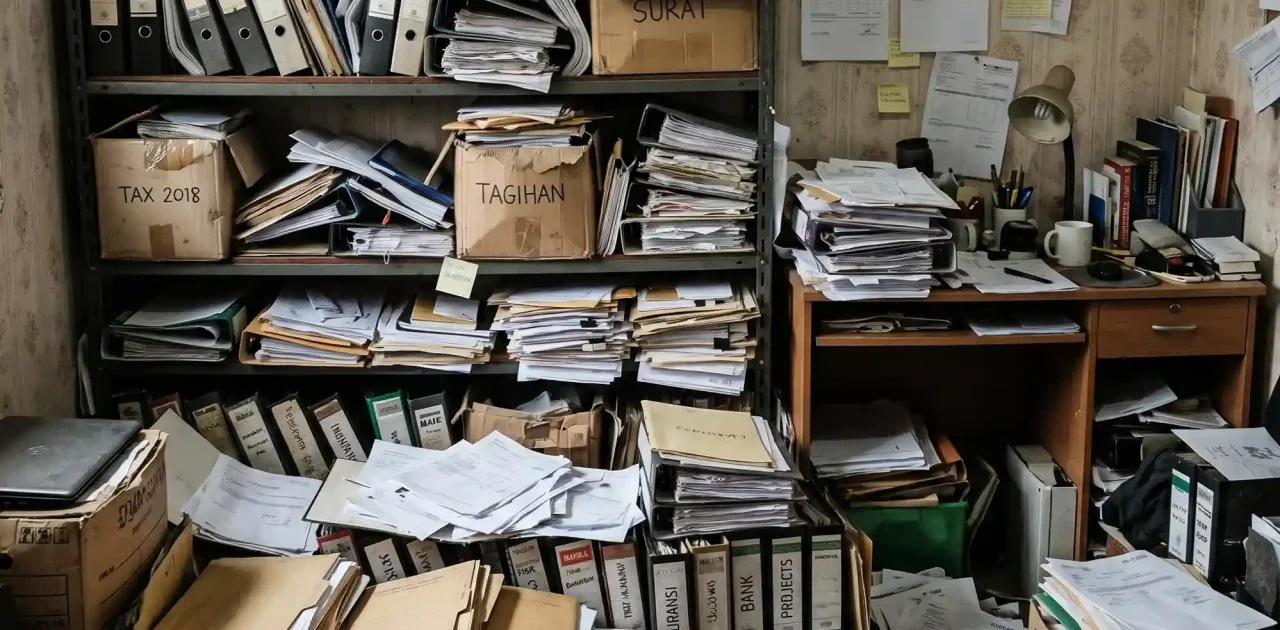
Many offices and schools feel they’ve made enough effort in managing their archives. Documents are arranged, shelves are labeled, and staff are instructed to store files properly.
However, within a few weeks, everything becomes messy again, hard to find, and frustrating for anyone who needs access.
If this situation feels familiar, it’s important to understand that the issue is not simply about tidiness or discipline. Organizing physical documents alone is not enough without a sustainable archiving system and clear procedures.
Common Problems in Archive Management
1. Documents Are Hard to Find
Staff know the document exists, but no one can be certain exactly where it is. The search process takes a long time and often ends without results.
Data shows that 86% of office workers have recreated documents that already existed in their system, simply because they couldn’t find them. This level of frustration even drives many employees to rewrite documents from scratch rather than continue searching.
2. Documents Get Mixed Up or Are the Wrong Version
When multiple versions of the same document are scattered in different locations, staff cannot always determine which one is the most up to date. As a result, there is a risk of decisions or actions being based on outdated documents.
3. Accessing Documents Takes Too Long
In urgent situations such as audits, inspections, or sudden data requests the inability to access documents quickly can directly impact an organization’s credibility and efficiency. Ideally, well-managed documents should be retrievable within minutes.
What Are the Root Causes of Messy Documents?
1. Lack of a Structured System
A structured system includes a clear category hierarchy, consistent naming rules, and a defined workflow from document intake to archiving.
Without these three elements, any organization effort is only temporary and depends on one or two individuals who remember where documents are stored.
2. No Standardization in Storage
This issue is closely related to the previous point but focuses on physical storage. When boxes, folders, and archive containers vary in size and format, shelf arrangements become inconsistent.
Documents from the same category end up stored in different types of containers. Labels are inconsistent, and stacked boxes become unstable.
3. Inadequate Storage Media
Storage media meaning the containers or boxes used for archiving directly affect how well an archive system can be maintained.
Weak cardboard boxes that easily bend cannot be stacked securely. Thin plastic folders tear easily and do not protect documents long-term. Non-uniform containers create inconsistent shelving that is difficult to manage.
When storage media cannot maintain their shape and function, the system itself gradually deteriorates.
Additionally, storage that is not resistant to humidity and dust accelerates document damage, especially in archive rooms without proper environmental control. As a result, documents that should be safely preserved deteriorate prematurely.
4. Archive Growth Without System Adjustment
Every organization generates new documents daily, but few actively manage this growth either by regularly filtering outdated documents or adjusting storage capacity.
As a result, shelves that were once neatly organized gradually become overcrowded. New documents are stacked on top of old ones, and categories begin to mix due to lack of space.
Under these conditions, even the best document organization systems will lose effectiveness over time.
What Needs to Be Improved?
If your archive system continues to fail despite repeated attempts to organize it, three fundamental aspects must be evaluated and improved simultaneously:
1. System
Is there a clear and consistent category hierarchy? Is there a documented workflow understood by all staff? A good system should function independently of any single individual.
2. Standards
Are there consistent guidelines for naming, numbering, and labeling documents? Clear standards eliminate ambiguity and ensure consistency even when staff changes.
3. Storage Media
Are the containers and boxes used capable of maintaining their structure over time? Are their dimensions uniform for consistent stacking? Are the materials resistant to humidity and repeated use?
This is where choosing the right file box becomes essential. Boxes made from PP corrugated offer lightweight strength, moisture resistance, and long-term durability while maintaining their shape even after years of use.
With consistent dimensions, these boxes support standardized shelving systems and uniform labeling across archive spaces. For office document storage and durable PP board archive boxes, ALVAboard offers a wide range of customizable solutions tailored to your office or school’s specific needs.

Through a wide range of products, including storage container solutions, ALVAboard is ready to help you build an archive system that stays organized not just today, but in the long term.
Consult your business storage needs with the ALVAboard team today and find a solution that helps your archive system last longer!