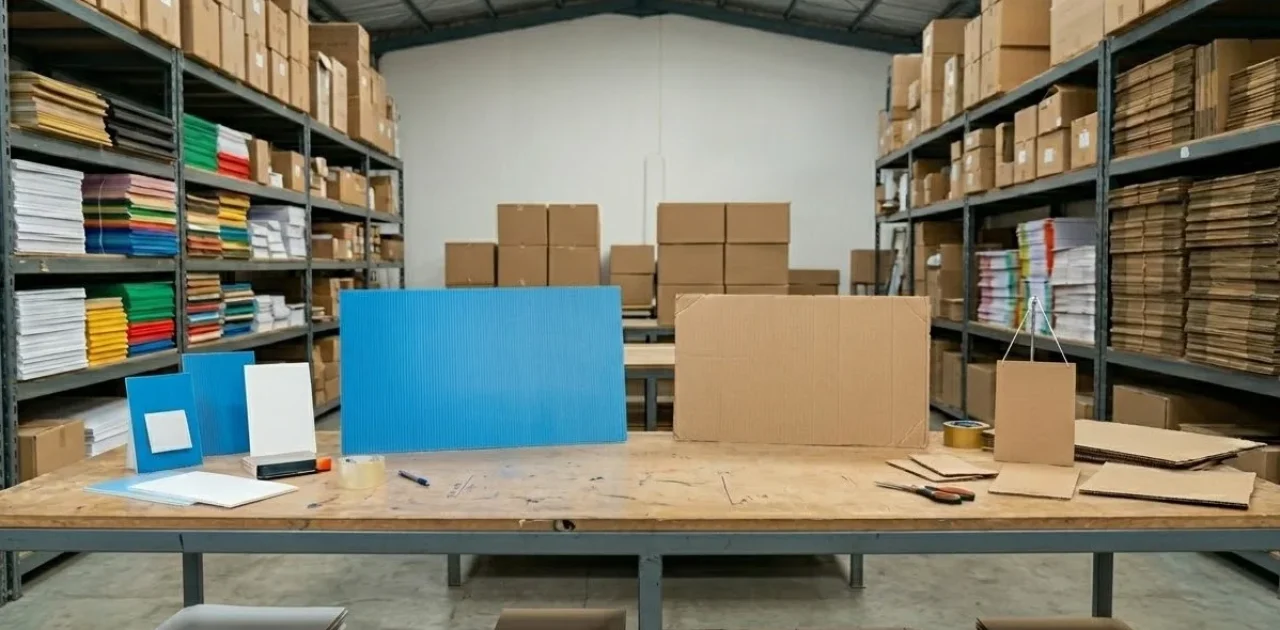
When marketing or procurement teams select materials for display boards, the first question that arises is: what is the price per unit?
Initial price comparisons are easy to perform, and the results are immediately visible on a budget spreadsheet. Unfortunately, this approach often overlooks factors that actually determine whether the display is truly cost-efficient in a real-world usage context.
The true cost of a display board is not determined by the initial production price alone. Factors such as lifespan, resistance to environmental conditions, replacement needs, logistics costs, and reusability all contribute to the total cost that must be calculated before a procurement decision is made.
PP corrugated and cardboard are the two most common materials used for display boards in the Indonesian market. Both can meet basic display media needs, but their cost characteristics differ depending on the usage strategy.
Basic Characteristics of Display Board Materials
Characteristics of PP Corrugated
PP corrugated is a plastic-based material with a layered structure consisting of two flat surfaces and a fluted middle layer. This structure provides strength, lightness, and flexibility that paper-based materials lack.
Physically, PP corrugated is water and moisture-resistant, does not tear or dent easily upon impact, and maintains its shape and strength in varying environmental conditions.
The surface can accept high-quality printing using the right techniques, and the material can be cut, folded, and shaped according to display design needs.
Characteristics of Cardboard
Cardboard is a paper-based material available in various thicknesses and constructions, ranging from single-layer to corrugated cardboard with a fluted paper layer in the middle. Cardboard offers an excellent printing surface with high color reproduction and graphic detail.
In terms of initial production costs, cardboard is generally cheaper per unit than PP corrugated, especially for large volume orders. The production process is also more accessible due to the widespread availability of manufacturing infrastructure.
The main limitations of cardboard are its sensitivity to water and moisture, low resistance to mechanical pressure, and short lifespan in non-ideal environments. Cardboard is essentially designed for a single-use cycle.
Initial Production Cost Component Comparison
From a material cost perspective, cardboard is cheaper per unit for comparable display specifications. Paper raw materials are easy to obtain, and the supply chain is highly efficient, making cardboard production prices more competitive at the initial procurement level. PP corrugated uses polypropylene raw materials, the price of which is influenced by petrochemical commodity prices and production processes.
Printing and finishing costs on cardboard are lower because the smooth paper surface easily accepts various printing techniques with consistent results.
PP corrugated requires specific printing techniques to produce equivalent graphic quality, which can add costs in some cases, although printing technology for plastic materials continues to evolve.
In terms of structural design and strength, cardboard requires complex construction to achieve strength equivalent to PP corrugated, which means more material or additional layers that increase costs. PP corrugated provides high structural strength per unit of weight and thickness.
For minimum orders and production processes, cardboard tends to be flexible for small orders due to lower setup costs. PP corrugated is usually more economical for medium to high volumes.
Operational Cost Comparison During Use
1. Lifespan
PP corrugated is designed for repeated use and, under normal conditions, can last for several campaign cycles without losing structural integrity or visual quality. A well-maintained PP corrugated display can be reused 3–5 times or more depending on usage conditions.
Cardboard, conversely, is a material designed for a single-use cycle. After one campaign period, cardboard is no longer in adequate condition for reuse without a significant decline in visual quality.
2. Environmental Resistance
PP corrugated is resistant to water, moisture, and reasonable weather exposure. It is much more reliable for displays in retail environments with AC, high-humidity areas, or displays exposed to water splashes. Cardboard exposed to moisture will undergo deformation, loss of strength, and a visual appearance that ruins the display’s aesthetics.
The durability of PP corrugated is also superior. Displays that are frequently moved, disassembled, and reinstalled will deteriorate faster if made of cardboard compared to PP corrugated.
3. Replacement Frequency
Replacement frequency is a hidden cost component often omitted from initial calculations. If a cardboard display must be replaced every campaign while a PP corrugated display can be used for several campaigns, the total procurement cost for PP corrugated over the same period can be lower despite the higher initial unit price.
As a simple illustration: if a cardboard display costing IDR50,000 per unit must be replaced every 3 months, the total annual cost is IDR200,000. A PP corrugated display priced at IDR120,000 that lasts 12 months results in a total cost that is 40% lower for the same period.
Logistics and Distribution Cost Comparison
Material weight affects shipping costs for distribution to multiple points simultaneously. PP corrugated is lighter per unit area than cardboard of equivalent strength, meaning shipping costs per unit can be lower and more units can be loaded into a single shipment.
The ease of handling for PP corrugated is also better because the material is not easily damaged by pressure or impact during loading and unloading. Cardboard that is pressed or folded during shipping can suffer damage that reduces the display’s visual quality before it is even installed.
The risk of damage during transport is lower for PP corrugated. Damage to a cardboard display during shipping means unplanned replacement costs and potential delays in campaign installation.
Furthermore, the need for additional protective packing for cardboard displays usually increases indirect logistics costs per shipment.
Total Cost of Ownership (TCO) Analysis
To make the comparison more concrete, here is a TCO simulation assuming a need for 4 campaigns a year distributed to 100 retail points.
Assumptions:
- Cardboard Display: IDR50,000/unit, 1-campaign lifespan, must be replaced every campaign.
- PP Corrugated Display: IDR120,000/unit, 4-campaign lifespan, reusable throughout the year.
- Logistics cost per shipment: IDR10,000/unit.
- Damage rate during shipping: Cardboard (10%), PP Corrugated (2%).
| Cost Components | Cardboard (per year) | PP Corrugated (per year) |
| Production Costs | IDR50.000 × 4 campaign × 100 unit = IDR20.000.000 | IDR120.000 × 1 time × 100 unit = IDR12.000.000 |
| Logistics Costs | IDR10.000 × 4 shipment × 100 unit = IDR4.000.000 | IDR10.000 × 1 shipment × 100 unit = IDR1.000.000 |
| Replacement Costs for Damaged Units | 10% × 400 unit × IDR50.000 = IDR2.000.000 | 2% × 100 unit × IDR120.000 = IDR240.000 |
| Total Annual Cost | IDR26.000.000 | IDR13.240.000 |
From this simulation, PP corrugated displays can achieve savings of approximately IDR12,760,000, or nearly 49%, compared to cardboard over one year of use under the same conditions. This difference increases as the number of distribution points and campaign frequency rises.
It is important to note that the figures above are illustrative with simplified assumptions. Actual results may vary depending on supplier production costs, logistics conditions, and usage intensity in the field.
Why PP Corrugated Display Boards Are More Cost-Effective
PP corrugated offers financial advantages in several specific use scenarios:
- Long-term or continuous campaigns: Campaigns lasting more than a month or ongoing campaigns that require durable displays clearly benefit from PP corrugated, which is more economical over time.
- Multi-location distribution: Delivering to multiple retail points simultaneously requires materials that withstand complex logistics. PP corrugated reduces damage during transit and lowers replacement costs for units damaged in the process.
- Frequent relocation: Displays moved regularly, such as for promotions between stores, need materials that can handle repeated assembly and disassembly. Cardboard quickly loses structural integrity when moved often.
- High-humidity environments: Areas near entrances, refrigerated spaces, or regions with high humidity can damage cardboard quickly. PP corrugated maintains optimal performance under these conditions.
- Sustainability programs: Initiatives that encourage reuse and reduce campaign waste benefit from materials that can be reused. PP corrugated supports these sustainability goals, unlike cardboard, which often becomes waste after each campaign.
Conclusion
PP corrugated and cardboard have fundamentally different cost structures. Cardboard excels in initial production costs and print quality for short-term, high-volume campaigns. PP corrugated, on the other hand, excels in total cost of ownership for repeated use, multi-location distribution, and environments that demand high material durability.
A total cost analysis considering lifespan, replacement frequency, logistics costs, and potential for reuse provides a more accurate decision-making basis than simply comparing initial prices.
For high-quality PP board display from an experienced PP board display manufacturer,ALVAboard can be a reliable reference to consider in the process of evaluating display materials for your next campaign.
Get in touch with the ALVAboard team now for further consultation on PP board displays!