When ordering an advertising display board, many companies immediately compare the unit price from several vendors without exploring what actually forms that price. As a result, decisions are made based on surface-level pricing that may not reflect the true total cost.
The production cost of display boards is influenced by various business factors, ranging from design complexity and distribution volume to logistics and maintenance costs. Understanding these factors from the planning stage helps the procurement team evaluate quotations more objectively, negotiate with a stronger basis, and avoid unnecessary cost overruns.
Why Does Procurement Need to Understand the Cost Structure of Display Board Production?
Vendor quotations often appear simple, consisting of only a few lines of numbers with the total price at the bottom. However, behind those numbers lies a more complex cost structure. Not all of its components are always explicitly listed by the vendor.
Hidden costs usually appear at several critical points. First, when design revisions occur after production has already started. Second, when the display is damaged during shipping and has to be reproduced.
Third, when installation requires on-site adjustments that were not anticipated from the beginning. Fourth, when the campaign ends and storage or disposal costs arise that were not included in the initial calculation.
By understanding the main cost drivers in display board production, the procurement team can compare price figures more effectively to truly assess the value of each proposal offered.
7 Business Factors That Determine the Production Cost of Advertising Display Boards
1. Design and Engineering Complexity
Design is one of the factors that most directly affects production costs. Displays with standard shapes and simple structures are generally cheaper to produce than displays with custom shapes, three-dimensional components, or special mechanisms such as hinges, slots, or knockdown systems.
Each additional design element increases production time, the cost of creating molds or die-cut tools, and revisions before the final product is approved. For large-volume orders, these setup costs are amortized over many units. However, for small orders with complex designs, the production cost contribution per unit can be significant.
2. Material Type and Visual Quality
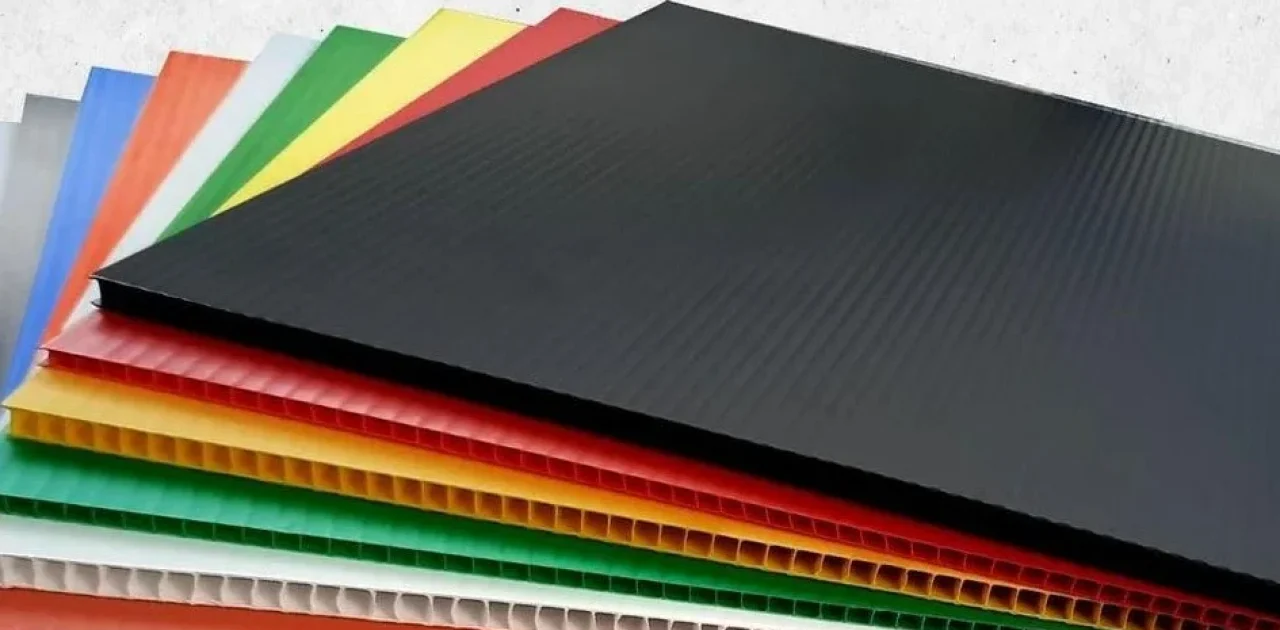
Advertising displays made from PP corrugated material offer characteristics such as lightweight, durability, and ease of printing. However, the quality between different material grades can vary significantly, and these differences are not always visually apparent at first.
Materials with consistent thickness and stable density produce displays that are more resistant to physical pressure and temperature changes in retail environments. The surface quality of the material also determines the sharpness of the print, which affects the visual appeal of the display at its placement location.
3. Production Volume and Distribution Scale
Order volume also significantly affects the unit price. Setup costs, production costs, and most overhead expenses are fixed, meaning they are spread over more units as the order volume increases.
For example, an order of 5,000 units of the same design can result in a lower unit price compared to an order of only 500 units.
Distribution scale also affects production complexity. Displays that will be distributed to hundreds of locations with varying conditions and sizes require complex packaging and labeling planning, both of which add costs beyond the production of the displays themselves.
4. Production Timeline and Deadline Urgency
When vendors are forced to complete orders faster than the standard lead time, they typically charge an additional rush fee. Furthermore, this acceleration requires vendors to adjust production line priorities, resulting in higher costs, as well as the use of express shipping services at premium rates.
5. Logistics and Shipping System
Logistics costs are a component that is often underestimated in calculating the total cost of a display board. Large displays or those with constructions requiring special packaging to prevent damage during shipping will incur higher logistics costs per unit compared to lightweight displays.
For distribution to multiple locations at once, shipping costs are also a significant component of the total cost. Asking vendors to include logistics cost estimates from the quotation stage provides a more accurate view of the total cost and helps avoid surprises at the end of the project.
6. Installation, Maintenance, and Lifecycle Usage
Displays intended for long-term use or that will be assembled and disassembled repeatedly require different material specifications and construction compared to single-use displays. These differences also affect production costs and determine the total cost of ownership over their usage period.
7. Design Revisions and Project Management
Sudden design revisions made during ongoing production risk wasting materials, forcing machine reconfigurations, and delaying the project schedule.
Vendors with a good project management system should establish design approval checkpoints before starting the manufacturing stage to minimize the risk of costly revisions. In addition to saving costs, this procedure also serves as an indicator of the vendor’s professionalism in managing the project.
Hidden Costs Often Not Included in Initial Calculations
There are several cost components that do not appear in the initial quotation but have the potential to increase the total expenditure.
- Reprints due to design errors. Mistakes discovered after production is completed require the entire batch to be reproduced at full cost, not including disposal costs for materials already produced.
- Damage during transportation. Displays that are not packaged according to standards are at risk of being damaged in transit. The cost of replacing damaged units is often not anticipated in the initial budget.
- Reinstallation at a different location. If displays need to be moved or installed at locations with conditions different from the original plan, additional installation costs may arise that are not included in the initial contract.
- Storage costs after the campaign ends. Displays that are not immediately used or need to be stored after the campaign incur storage costs, which are rarely accounted for in the initial procurement calculation.
- Replacement of damaged components. Displays intended for repeated or long-term use will experience wear on certain components, requiring periodic replacement.
How to Anticipate Production Costs from the Planning Stage
There are several steps that can be taken to gain an accurate understanding of costs and avoid budget overruns during the project.
- Define the purpose of the display specifically before contacting the vendor, including the duration of use, placement location, and whether the display will be used repeatedly or only for a single campaign.
- Finalize the design before requesting a quotation. Design changes after the quotation is received will alter the cost structure.
- Request a detailed cost breakdown from each vendor, not just the total unit price. A transparent breakdown allows for objective comparison and provides room for negotiation.
- Include logistics and installation costs as part of the total budget from the beginning. Do not treat them as separate components to be calculated later.
- Evaluate the display’s usage lifecycle and compare the total cost of ownership across vendor options, not just the production cost per unit.
Conclusion
The production cost of advertising display boards is influenced not only by materials and size. Business factors such as design complexity, production timeline, distribution scale, and quality control standards are often the largest sources of hidden costs, which only become apparent once the project is underway.
Therefore, careful planning and a comprehensive cost analysis from the early stages are essential. Procurement teams that understand the production cost structure will be better prepared to evaluate vendors objectively and make strategic sourcing decisions.
For advertising display boards made from PP corrugated material, the quality of the material and production consistency are the two most important factors determining on-site performance. It is essential to choose a PP board manufacutrers that is experienced and transparent in its cost structure.
ALVABoard is one of the premium PP board manufacturers that can serve as a reference in evaluating vendors for your business display needs. For more details, contact the ALVAboard team today.