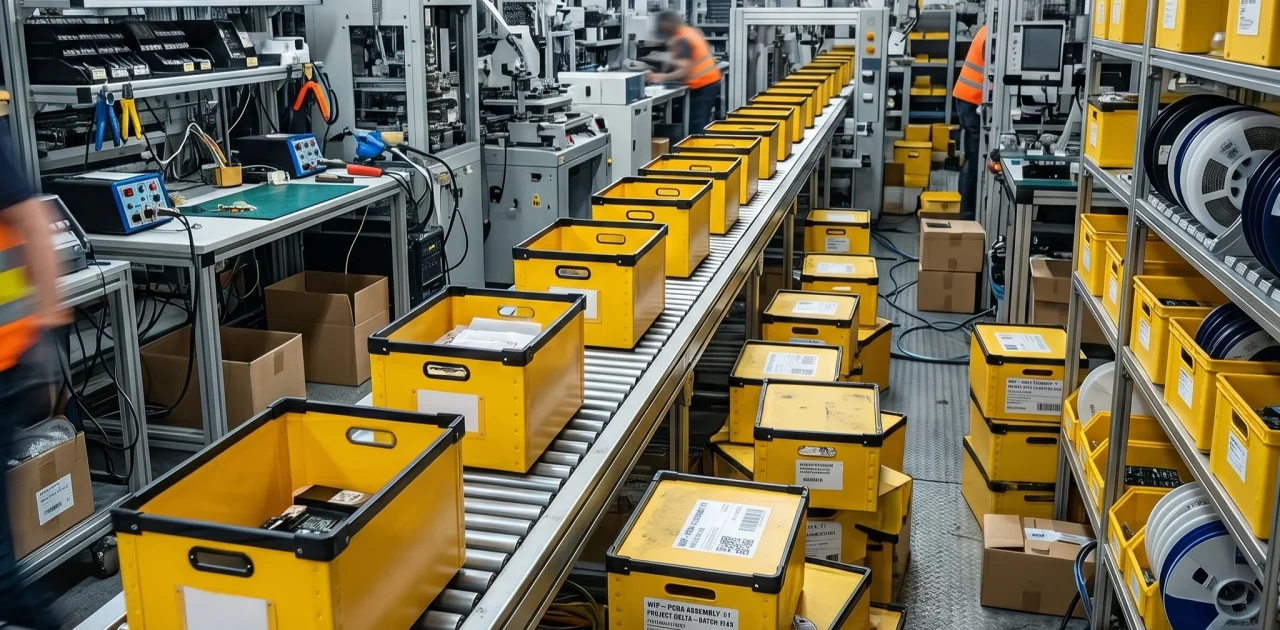
When production lines begin to slow down, management’s first response is usually to check machines, evaluate operators, or audit production schedules.
Machines are often assumed to be the problem. Human resources are seen as lacking discipline. While both are valid factors to examine, they are often not the primary source of the issue.
In many FMCG factories, bottlenecks actually stem from less visible factors, such as inefficient material and Work-in-Progress (WIP) management.
The flow of semi-finished goods from one station to another has a significant impact on the overall efficiency of the production system.
Signs of Bottlenecks in Production Lines
Before discussing the causes, it is important to understand how bottlenecks appear on the production floor. Many of these signs have existed for a long time but are often considered “normal” by production teams.
1. Accumulation of Materials at Specific Points
If certain areas on the production floor are consistently filled with materials or WIP products while others remain relatively empty, this likely indicates a bottleneck.
Materials pile up because the process at that point cannot keep up with upstream operations.
2. Long Waiting Time Between Processes
Operators may appear idle not due to a lack of work, but because materials are not ready or have not arrived from the previous station. Every minute of waiting equals lost production time.
3. Machines Sitting Idle at Multiple Points
When machines stop not due to scheduled maintenance but because there is no incoming material, it indicates a serious imbalance in the production flow.
4. Inconsistent Output Across Shifts
When the amount of WIP accumulating in one area is significantly higher than in others, it is a strong indication of a bottleneck.
When overall production flow efficiency is low, most process time is spent waiting rather than producing.
All of these signs represent inefficiencies that occur daily on the production floor. However, because they are often normalized, they are rarely investigated down to their root causes.
Common Causes of Bottlenecks (and Often Overlooked Ones)
Several causes of bottlenecks are already well known to production management:
- Imbalanced production capacity, where one station operates significantly slower than others, causing material queues and slowing the entire line.
- Suboptimal factory layout, forcing materials to travel longer distances than necessary.
- Lack of coordination between processes, resulting in disconnected operations some stations produce excess output while others lack input.
- Inefficient WIP management, which is often overlooked but plays a crucial role. This includes how WIP is moved, stored, and controlled throughout the process.
The Role of WIP in Production Flow
WIP acts as the connector between every process in the production line. Each unfinished product is material in transit from one stage to the next.
Therefore, how WIP is stored, moved, and identified directly impacts the smoothness of the entire production flow.
If WIP is not properly managed, the consequences can be significant.
First, materials become difficult to locate when needed, especially without standardized containers or clear identification systems.
Second, WIP movement between stations becomes slow and inconsistent due to the lack of proper transport media.
Third, The risk of product damage increases when materials are stacked improperly or moved without adequate containers.
For example, if 200 units of WIP are queued at one workstation while only 10 units exist at another, it clearly signals a bottleneck at that point.
Additionally, materials that remain too long in WIP status are at risk of damage, deterioration, or even becoming unusable.
Key Characteristics of Efficient WIP Boxes
One of the most overlooked solutions for improving WIP management is selecting the right WIP box.
The container used to store and transport WIP is not a trivial decision. Its physical characteristics directly affect the speed and safety of material flow on the production floor.
Here are key characteristics to consider:
- Lightweight yet strong. Boxes that are too heavy slow down operators, while boxes that are too light but not durable risk damaging the products inside.
- Easy to handle. Ergonomic design and standardized dimensions allow operators to carry, stack, and move WIP quickly and efficiently.
- Resistant to production conditions. FMCG production floors can be harsh environments, with humidity, dust, liquid spills, and daily physical stress. WIP boxes must withstand these conditions without deformation or reduced lifespan.
- Standardizable. Uniform dimensions enable consistent stacking, compatibility with storage racks, and accurate production capacity calculations. Standardization also supports visual labeling and WIP identification systems.
The good news, ALVAboard offers PP corrugated WIP boxes that meet all of these requirements. In addition, various specifications are available and can be customized to match your factory’s specific production flow.
With a wide range of products, including container solutions for various industrial applications, ALVAboard is ready to help you find the most efficient configuration.
Consult your WIP box needs with the ALVAboard team today and discover the most suitable material handling solution for your production flow.