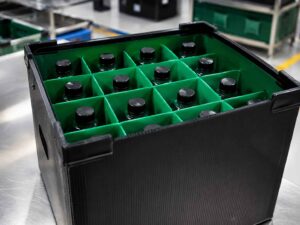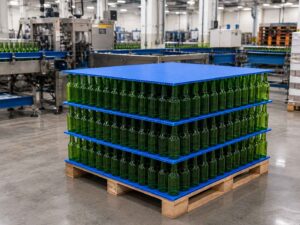
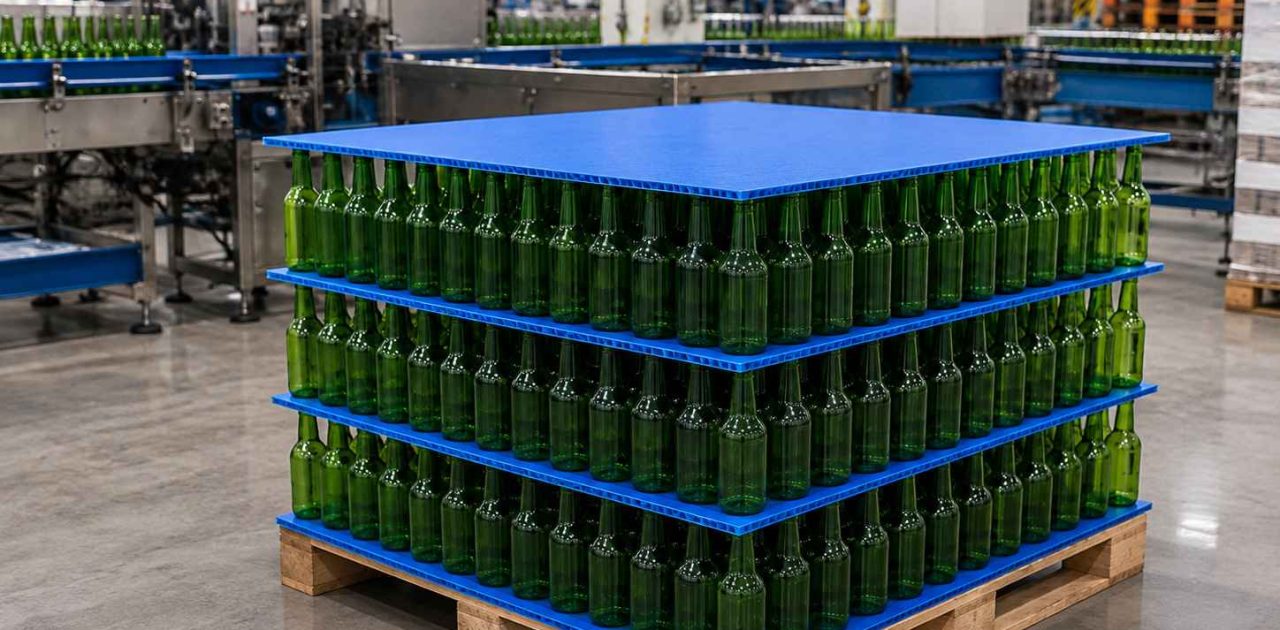
Production layer pads made from Polypropylene (PP) corrugated help maintain the stability of products stacked on pallets because they are lightweight, water-resistant, tear-resistant, and reusable. For production lines that require cleanliness and consistent dimensions, PP material such as ALVAboard can be an alternative to cardboard layer pads that are easier to clean and can be designed according to palletization requirements.
The Vital Role of Layer Pads in Pallet Arrangement and Industrial Logistics
Layer pads function as separator sheets between product layers on pallets to help distribute the load and keep the stack stable. In practice, this simple component plays an important role when a single pallet contains dozens to hundreds of bottles, cans, or packages that need to be moved from the production line to the warehouse and then onto distribution vehicles.
Problems usually arise when the separator base used is prone to deformation. Cardboard can weaken when exposed to water or moisture, while its flakes and dust are also less ideal for areas that require high cleanliness standards.
For factory operations managers, the issue is not simply choosing a strong material. Layer pads must also have consistent dimensions, be easy for operators to handle, not interfere with the palletization process, and able to keep up with the pace of production.
This is where manufacturing experience becomes important. ALVAboard, produced by PT Alpha Gemilang Makmur, provides PP corrugated sheets for various industrial applications, including layer pads, WIP boxes, and dividers. The production process is carried out in-house at its Tangerang facility, allowing the development of custom products to be adjusted according to application requirements.
As a pioneer in the corrugated plastic industry, ALVAboard continues to develop the use of PP materials for industrial needs that require a combination of strength, cleanliness, and reusability. This experience is one of the reasons ALVAboard is positioned as a manufacturer offering the best solutions in Indonesia for customizable PP corrugated applications.
Advantages of ALVAboard Polypropylene Production Layer Pads
Water Resistance, Temperature Resistance, and Hygiene
PP corrugated layer pads have the main advantages of being resistant to water and moisture, as well as an easy-to-clean surface. These characteristics make them more suitable for production environments that may be exposed to water splashes, condensation, or routine cleaning processes.
ALVAboard uses polypropylene material with a temperature resistance range stated in its product information of approximately -20°C to 130°C, allowing it to be used for applications exposed to both cold and hot conditions. PP material is also non-organic, making it resistant to termites.
For food-related applications, ALVAboard also has information on FDA Food Grade, BPOM, and Halal certifications, while its quality management system uses the ISO 9001:2015 standard.
For procurement teams, details like these are important because choosing a layer pad is not only about the price per sheet. Factors cleanliness, washability, material consistency, and service life also determine the total cost of ownership.
Rounded Corners and Precise Dimensions for Palletization
Production layer pads used in the palletization process should have dimensions and shapes so they do not interfere with stacking or handling.
ALVAboard can be customized based on the required size, thickness, color, and shape. PP boards are available in various thicknesses, and official ALVAboard sources list thicknesses ranging from 2 mm to 12 mm for various applications.
For layer pads, details such as rounded corners can also be considered. More rounded and neatly finished corners help reduce the risk of the corners interfering with stretch film or getting caught when operators perform handling.
The surface of PP boards can also be printed, allowing the application of color codes, company identification, or specific markings according to the factory’s work system.
ALVAboard Official Shopee Store
Comparison of Cardboard Layer Pads and ALVAboard PP Layer Pads
The main differences between cardboard layer pads and PP corrugated are their resistance to environmental conditions, reusability, and ease of maintenance.
| Parameter | Cardboard Layer Pad | ALVAboard Layer Pad |
| Water resistance | Limited | Water-resistant |
| Moisture resistance | May weaken | More stable |
| Cleanliness | Difficult to wash | Easy to clean |
| Flakes/dust | May produce fibers | Does not produce paper dust |
| Tear resistance | Depends on cardboard grade | Tear-resistant |
| Repeated use | Limited | Reusable |
| Customization | Available, depending on the material | Size, thickness, shape, and color can be customized |
ALVAboard itself describes PP layer pads as a solution for the beverage and manufacturing industries, with hygienic, dust-free, chemical-resistant, tear-resistant, and reusable characteristics of up to 50 cycles for the layer pad product displayed on its official page.
Therefore, the number of reuse cycles should be determined based on the design, thickness, load, handling method, and actual operating conditions, rather than simply using a single value for all applications.
Operational Cost Efficiency and Material Circularity
The advantages of reusable layer pads are not only reflected in their durability, but also in their usage costs over their service life. When a single layer pad can be used multiple times, the need to purchase and dispose of single-use materials can be reduced.
However, to calculate savings realistically, procurement teams should use a cost-per-use approach. The initial purchase price should be compared with the actual number of usage cycles, washing costs, damage rates, and waste management costs.
ALVAboard also places the use of recyclable materials as part of its sustainability approach. PP corrugated can enter the recycling stream after its service life is complete.
With an in-house production facility and experience serving various sectors, ALVAboard is a trusted choice for companies that need PP corrugated solutions with consistent specifications. For specific needs, the highest-quality material does not necessarily mean having excessive specifications, but rather having specifications that are appropriate for the actual load and usage conditions.
Improve Production Line Safety Standards with ALVAboard
The right layer pad should be selected based on the characteristics of the products, pallet size, load of each layer, handling method, and production environment conditions. Therefore, before making a large-volume purchase, plant managers, packaging engineers, and procurement teams should test samples first.
ALVAboard can help translate these requirements into material specifications, dimensions, thickness, corner shapes, as well as color or marking requirements. With manufacturing experience and a production facility in Tangerang, custom requirements can be discussed directly based on actual field conditions.
If your company is looking for separator layer pads for bottles and cans, factory stack separators, or corrugated plastic layer pads for distribution needs, technical consultation is a safer first step than simply comparing prices per sheet.
CONSULT YOUR PRODUCTION LAYER PAD REQUIREMENTS
Discuss your layer pad dimensions, thickness, shape, and usage requirements with the ALVAboard team. Get samples and solutions tailored to your production line, palletization, and distribution needs directly from the main factory.
ALVAboard is a corrugated plastic manufacturer that is part of an experienced plastic manufacturing group, committed to providing consistent, efficient, and customizable solutions for industrial operational needs.
Let’s discuss your production layer pad, pallet separator, or custom corrugated plastic requirements for your manufacturing and distribution lines with the ALVAboard team via WhatsApp +62 877-9310-2838, or click the button below now!