Many warehouse owners focus on improving shelving systems, but often forget that the wrong box is actually the real source of problems. Boxes that are too large, too small, or easily damaged waste space and continuously increase operational costs.
Fortunately, this issue can be solved by choosing warehouse boxes that truly match operational needs.
How Warehouse Boxes Affect Storage Efficiency
1. Optimizing Warehouse Space Utilization
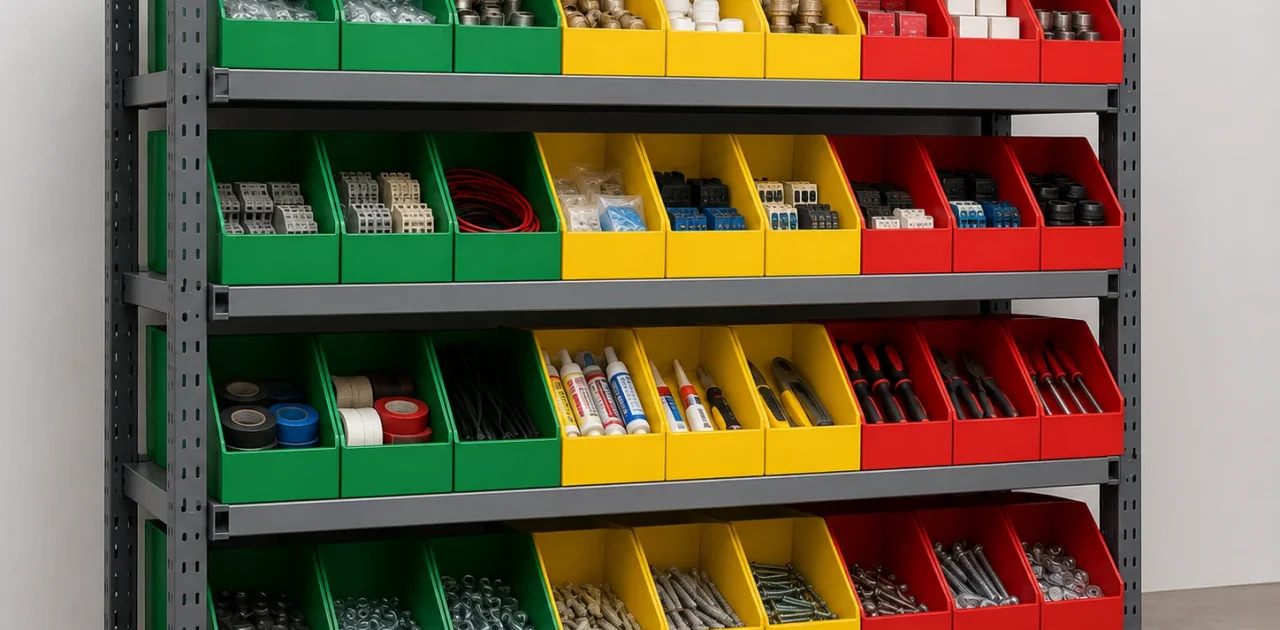
Boxes with sizes that fit storage racks help maximize warehouse space usage. Each rack slot can be filled without leaving unnecessary empty gaps.
On the other hand, boxes that are too large may not fit properly into racks, while boxes that are too small lead to underutilized storage capacity.
In addition to size, stackable boxes also play an important role in storage efficiency. Stacking boxes maximizes vertical space, allowing more goods to be stored within the same area.
Learn more about racking systems to understand how the right shelving system can maximize warehouse storage capacity.
2. Speeding Up Item Searching and Picking Process
Warehouse boxes with clear labels help operators find items much faster. These labels can include product names, item codes, barcodes, QR codes, or color coding systems.
With easy-to-read identification, operators do not need to open or check multiple boxes to locate the required items.
In addition, using uniform boxes makes the storage layout more organized and structured. Items can be placed in predefined locations, making searching, picking, and moving goods much faster.
Box design also affects handling efficiency. Boxes with handles and appropriate size and weight are easier for operators to lift, move, and arrange.
Learn more about how to organize warehouse items to improve the searching and picking process.
3. Protecting Goods from Damage Risks
One of the main functions of warehouse boxes is to keep goods safe during storage and transportation. Strong boxes can protect items from impact, pressure, and being crushed by other goods.
For small or fragile items, using dividers inside the box is very helpful.
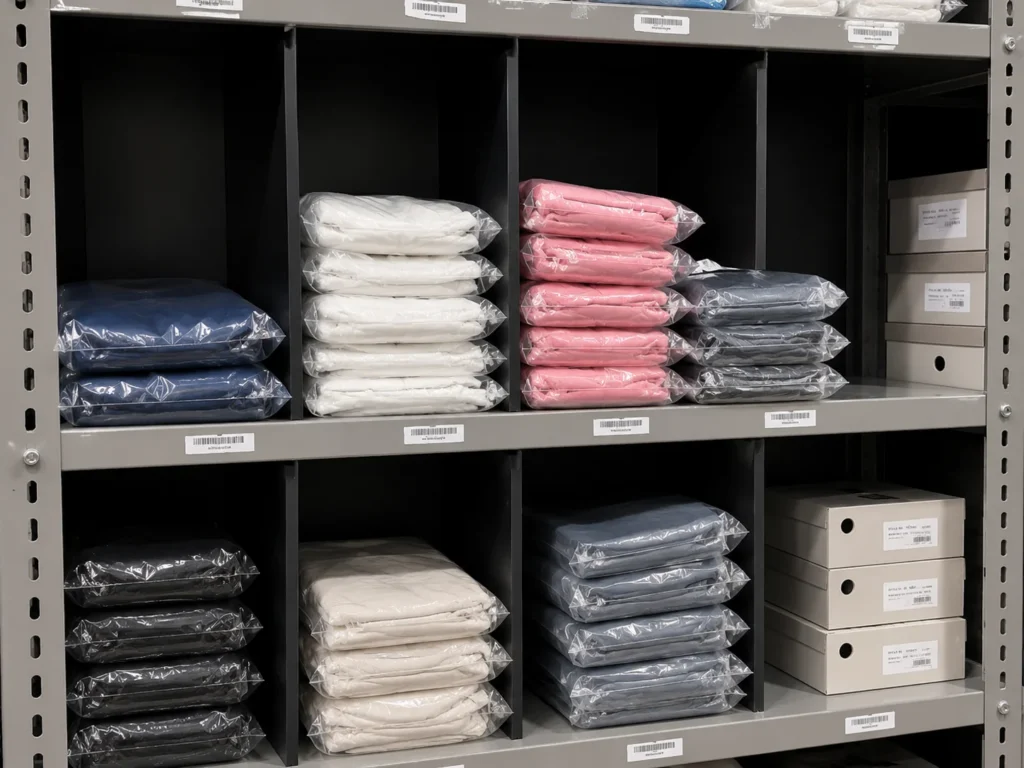
Dividers separate each item so they do not collide, rub against each other, or get mixed with other products.
Besides box design, the material used also affects the level of product protection. Strong materials can withstand stacking pressure without easily denting or deforming.
If the material is also water-resistant and moisture-resistant, the risk of damage caused by storage conditions can be significantly reduced.
4. Supporting Inventory Management Systems such as FIFO
Warehouse boxes with clear labeling help companies implement the FIFO (First In, First Out) system, where items that enter first must be used or shipped first.
This system is especially useful for products with limited shelf life to ensure they are not stored too long in the warehouse.
Through labels such as receiving dates, batch numbers, or production codes, operators can easily identify which items should be prioritized for outbound processing.
The picking process becomes faster and reduces the risk of errors in stock rotation.
5. Reducing Long-Term Operational Costs
Strong and durable warehouse boxes can help companies save costs in the long run.
Although the initial price may be higher, high-quality boxes are less likely to be damaged and do not need frequent replacement. This reduces repeated purchasing costs for new boxes.
In addition, sturdy boxes also help protect goods during storage and handling processes.
If boxes are easily dented, torn, or damaged, the items inside are more likely to be exposed to impact, pressure, or even falling.
Such damage can lead to additional costs such as return handling, customer claims, product replacement, or unsellable inventory.
The Role of PP Board Warehouse Boxes in Warehouse Optimization
Among various material options, PP board is one of the most suitable materials for modern warehouse box needs.
This material has a hollow structure, making it lightweight yet still strong enough to be used as a storage container for goods.
In addition, its surface does not easily absorb water, making it resistant to moisture and easy to clean.
In warehouse operations, PP board can be used for various purposes.
It can be formed into storage boxes to separate items based on SKU, size, product type, or specific categories.
PP board can also be used as dividers or separators inside racks to prevent items from mixing and make them easier to locate.
ALVAboard produces various PP board warehouse boxes, including bin boxes for storage and shipping that can be customized according to your rack dimensions.
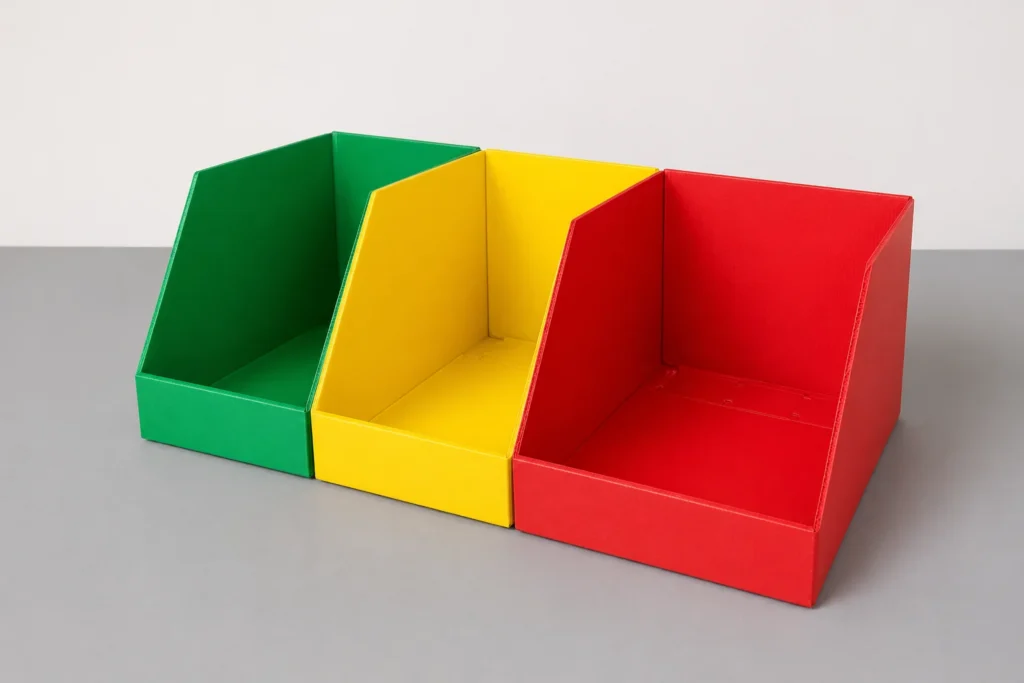
This box is made from high-quality Polypropylene (PP) material that is lightweight, strong, waterproof, and resistant to mold and termites, making it suitable for warehouse and logistics operations.
ALVAboard bin boxes are also tear-resistant and break-resistant, able to withstand impact and pressure up to 130°C, and easy to clean by wiping or washing.
These boxes have a long service life and can be reused multiple times, reducing the need for frequent replacements in the long term.
In addition to being available in various sizes and six color options (green, yellow, blue, red, white, and black), ALVAboard bin boxes can also be customized according to rack dimensions and your business operational needs.
Available in three sizes with 3 mm thickness:
- Storage Bin Small — 19 x 39 x 30 cm
- Storage Bin Medium — 24 x 39 x 30 cm
- Storage Bin Large — 33 x 39 x 30 cm (Price: Rp46,950)
For the latest pricing information and bulk orders, consult your warehouse racking box needs with the ALVAboard team via WhatsApp +6287793102838 now!