Distribution costs in the FMCG industry continue to rise year after year. Transportation tariffs are increasing, warehouse costs are growing, and packaging material prices are also climbing.
Amid this pressure, many distribution managers are looking for ways to cut costs without compromising product safety.
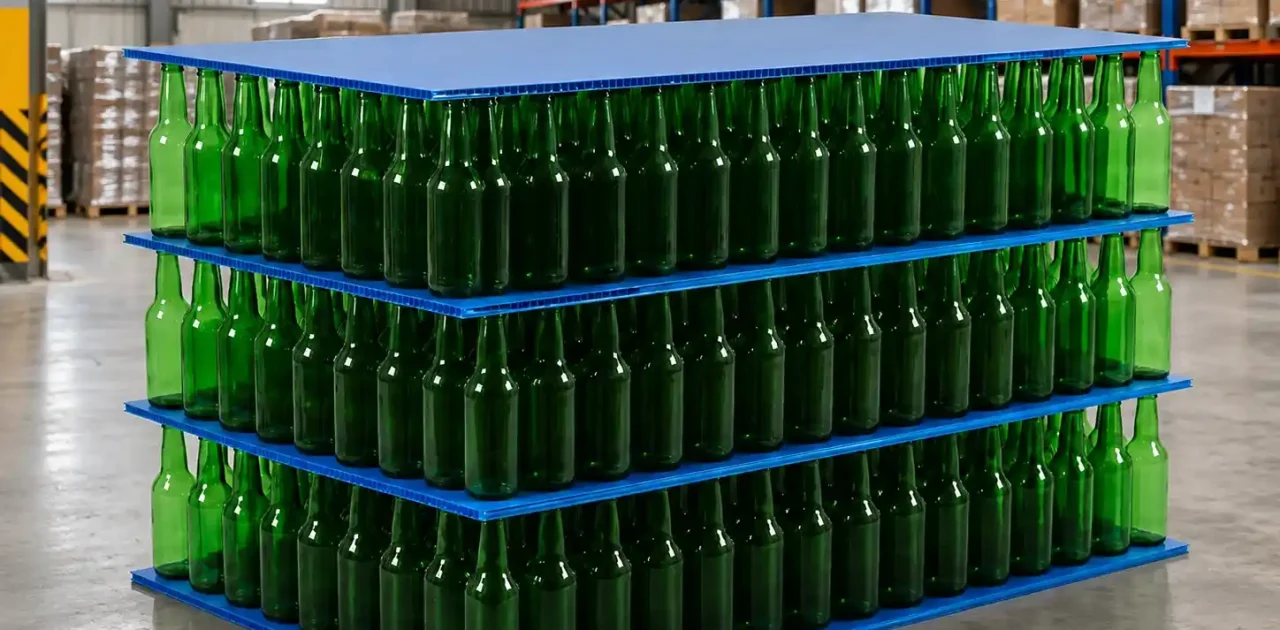
Layer pads for pallet stability are one cost component that is often considered small, but in reality has a significant cumulative impact.
The problem is, without a concrete simulation, it is difficult to understand how much cost-saving potential can actually be achieved through layer pads.
Therefore, this article presents a cost-saving simulation framework per pallet, along with a case study as a reference for your distribution conditions.
What Is Cost per Pallet in FMCG Distribution?
Cost per pallet is the total cost incurred to process one pallet of products from the shipping point to the receiving point.
This figure is often understood only as transportation cost. However, several other components contribute to the total cost per pallet, including:
- Packaging materials. Includes purchase cost of layer pads, dividers, or other protective materials used in each pallet.
- Usage frequency. How many times packaging materials can be reused before replacement. This determines effective cost per use.
- Handling cost. Time required by operators to install, remove, and store layer pads in each cycle.
- Replacement cost. How often materials must be replaced due to damage or unfit condition.
When all components are summed, the actual cost per pallet is often very different from initial estimates that only consider material price.
Cost Saving Simulation Framework per Pallet
Before running a simulation, five main variables must be defined:
- Monthly pallet volume. Total pallets processed per month?
- Shipping frequency. How many times each pallet is shipped and returned in the distribution cycle per month?
- Type of packaging used. Whether using disposable or reusable layer pads?
- Material lifespan. how many times a layer pad can be used before replacement?
- Unit material cost. purchase price of the current layer pad and the reusable alternative being considered?
Dengan lima variabel ini, simulasi penghematan bisa dilakukan dengan akurat dan hasilnya bisa langsung dibandingkan.
Case Study: Cost Saving Simulation Using Reusable Layer Pads
To clarify the concept, here is a concrete simulation based on a common FMCG distribution scenario.
Base assumptions:
- Distribution volume: 500 pallets per month
- Layer pads per pallet: 4 sheets
- Total layer pad demand per month: 2,000 sheets
Scenario A: Disposable Layer Pads (Cardboard)
- Price per sheet: Rp3,500
- Average usage: 1.5 times
- Effective cost per use: Rp2,333
- Monthly cost (2,000 sheets): Rp7,000,000
- Annual cost: Rp84,000,000
- Waste disposal cost (estimate): Rp500,000/month
- Total annual cost including disposal: Rp90,000,000
Scenario B: Reusable Layer Pads (PP Corrugated Sheet)
- Price per sheet: Rp28,000
- Average usage: 40 times
- Effective cost per use: Rp700
- Initial investment (2,000 sheets): Rp56,000,000
- Monthly amortization (40 months): Rp1,400,000
- Handling and cleaning cost: Rp300,000/month
- Total effective monthly cost: Rp1,700,000
- Total annual cost: Rp20,400,000
Simulation Results
| Aspect | Disposable Cardboard | Reusable PP Corrugated |
| Cost per sheet | Rp3,500 | Rp28,000 |
| Lifespan | 1,5 uses | 40 uses |
| Cost per use | Rp2,333 | Rp700 |
| Total annual cost | Rp 90,000,000 | Rp20,400,000 |
| Annual savings | Rp69,600,000 | |
| Savings percentage | 77.3% |
In this scenario, the initial investment for reusable layer pads reaches the break-even point in approximately 10 months. After that, every subsequent month generates net savings of around Rp 5.8 million compared to disposable systems.
Factors Affecting the Level of Savings
The simulation above is based on certain assumptions. In practice, savings depend on several factors:
1. Distribution Volume
The higher the monthly pallet volume, the faster the initial investment is recovered and the greater the cumulative savings.
Low-volume companies may take longer to reach the break-even point.
2. Handling System
Does your distribution system operate in a closed-loop cycle where layer pads are returned after each shipment?
A closed-loop system is essential to maximize reusable material benefits. Without a structured return system, effective lifespan will be significantly reduced.
3. Material Quality
Not all PP corrugated layer pads have the same durability. Low-density or inconsistent thickness materials will have shorter lifespans, directly affecting cost per use.
Choose suppliers with verified quality control standards to ensure expected lifespan is achieved.
4. Duration of Use
The longer the usable lifespan per batch of layer pads, the greater the savings.
High-quality PP corrugated materials that are well maintained can exceed conservative estimates of 40 uses.
When Are Reusable Layer Pads the Right Choice?
Reusable layer pads provide the most financial benefit under certain operational conditions. The following indicators show that switching to a reusable system will result in significant savings.
- High and consistent distribution volumes. Companies that routinely process hundreds to thousands of pallets per month will benefit the most.
- Regular distribution with fixed routes. A distribution system with regular routes and schedules simplifies the management of layer pad returns.
- High pallet stability requirements. FMCG products that are prone to shifting or damage during transport require layer pads that provide consistent stability.High pallet stability requirements.
- Commitment to reducing long-term costs. The decision to switch to reusable layer pads requires a larger initial investment.
ALVAboard: PP Corrugated Layer Pad Solution for More Efficient FMCG Distribution
ALVAboard provides reusable PP corrugated layer pads that can be customized according to pallet dimensions and your specific distribution system needs.
Through various product options, including dividers and layer pad applications, ALVAboard supports the design of more efficient packaging systems for long-term distribution needs.
To better understand layer pads for logistics safety and efficiency, ALVAboard’s technical team is ready to provide guidance tailored to your specific operational conditions.
Consult your PP corrugated sheet and reusable layer pad needs with the ALVAboard team via WhatsApp +6287793102838!